1. What Cold Email Is (and Isn't)
Cold email is a form of outbound communication where you send an email to a potential customer, client, partner, or stakeholder with whom you have had no previous interaction. Unlike inbound marketing, where prospects discover your business through search engines, social media, or referrals, cold email allows you to proactively reach the right people and introduce your product, service, or idea.
The primary objective of a cold email is not to make an immediate sale. Instead, its purpose is to spark interest, start a meaningful conversation, and open the door for future communication. A successful cold email focuses on building trust, demonstrating relevance, and providing value before asking for a commitment. Whether you're looking to book a discovery call, schedule a product demo, establish a partnership, recruit talent, or generate B2B leads, cold email remains one of the most cost-effective and scalable outreach methods.
Cold Email vs. Spam
One of the biggest misconceptions is that cold email is the same as spam. While both involve sending unsolicited emails, they differ significantly in intent, targeting, and execution.
A professional cold email is:
Sent to a carefully researched and relevant audience.
Personalized based on the recipient's company, role, or business needs.
Focused on solving a specific problem or offering genuine value.
Short, respectful, and easy to read.
Includes a clear but non-pushy call to action.
Gives recipients an easy way to decline or opt out of future communication.
Spam, on the other hand, is:
Sent to large, untargeted email lists.
Generic and lacks personalization.
Primarily promotional or sales-focused.
Often contains misleading subject lines or exaggerated claims.
Ignores the recipient's interests or needs.
Frequently violates email marketing regulations and damages sender reputation.
Why Cold Email Still Works
Despite the rise of social media and other digital marketing channels, cold email continues to be a highly effective strategy for businesses because it creates a direct line of communication with decision-makers. When emails are personalized, relevant, and sent to the right audience, they can generate high-quality conversations, qualified leads, and valuable business opportunities.
The key to successful cold email isn't sending more emails it's sending better emails that are personalized, helpful, and genuinely relevant to the recipient.
2. Legal & Compliance Basics
Before launching any cold email campaign, it's essential to understand the legal and compliance requirements that apply to your target audience. Cold email is a legitimate marketing and sales strategy, but it must be conducted responsibly and in accordance with regional regulations. Since email laws vary across countries, businesses should always familiarize themselves with the rules in the jurisdictions where their recipients are located. Following these regulations not only helps you avoid legal issues but also protects your sender reputation and builds trust with potential customers.
CAN-SPAM Act (United States)
The CAN-SPAM Act establishes the basic rules for commercial email in the United States. It requires businesses to provide accurate sender information, use honest and non-deceptive subject lines, include a valid physical mailing address, and offer recipients a clear and functional way to unsubscribe. If a recipient opts out, the request must be honored within 10 business days. Businesses should also avoid sending emails to purchased or harvested email lists obtained through deceptive practices, as these can lead to compliance issues and damage sender reputation.
GDPR (European Union)
The General Data Protection Regulation (GDPR) focuses on protecting personal data and privacy for individuals within the European Union. In many B2B cold email scenarios, businesses rely on a legitimate interest as the legal basis for outreach, although the interpretation of this principle varies by country. Some countries, such as Germany, have stricter rules regarding unsolicited business communication. Organizations must also be transparent about how they obtained contact information, provide an easy way for recipients to opt out of future emails, and comply with requests to delete personal data when required by law.
CASL (Canada)
The Canadian Anti-Spam Legislation (CASL) is considered one of the strictest email marketing regulations in the world. In most cases, businesses are required to obtain consent before sending commercial electronic messages, although there are limited exceptions depending on the nature of the business relationship. Companies planning to contact Canadian recipients should carefully review CASL requirements before launching any outreach campaigns to ensure full compliance.
Practical Compliance Checklist
In addition to understanding regional laws, businesses should follow a few universal best practices to maintain trust and improve email deliverability. Always send emails using your real name or company identity and provide a valid reply-to email address so recipients can easily respond. Include a physical mailing address or clear company information in your email footer to establish credibility and transparency. Every email should offer a simple way for recipients to unsubscribe, and any request to stop receiving emails should be processed immediately. Avoid purchasing scraped or low-quality email lists, as they often lead to poor engagement, spam complaints, and a damaged sender reputation. Finally, maintain a suppression list and check it before every campaign to ensure contacts who have opted out are never contacted again.
By prioritizing transparency, respecting recipient preferences, and following applicable regulations, businesses can create compliant cold email campaigns that are both effective and trustworthy. While these guidelines provide a general overview of major compliance frameworks, they are intended for informational purposes only and should not be considered legal advice. If your outreach spans multiple countries or involves complex compliance requirements, consult a qualified legal professional to ensure your campaigns meet all applicable laws.
3. Building Your Prospect List
The success of any cold email campaign starts with the quality of your prospect list. Sending emails to the right people is far more effective than reaching thousands of random contacts. A well-researched list of 200 highly relevant prospects will almost always generate better response rates, more qualified leads, and higher conversions than a generic list of 5,000 contacts. By investing time in building a targeted prospect list, you can create personalized outreach that resonates with recipients and significantly improves campaign performance.
| Step | What to Do | Why It Matters |
|---|
| Define Your Ideal Customer Profile (ICP) | Identify your target industry, company size, decision-maker roles, location, technology stack, and buying signals. | Ensures you're contacting businesses that are most likely to benefit from your solution. |
| Source High-Quality Contacts | Use trusted prospecting platforms like LinkedIn Sales Navigator, Apollo, Clay, ZoomInfo, or Crunchbase to find relevant decision-makers. | Provides accurate prospect data and helps identify qualified leads for outreach. |
| Verify Email Addresses | Validate every email address using tools such as NeverBounce, ZeroBounce, or MillionVerifier before launching your campaign. | Reduces bounce rates, protects sender reputation, and improves email deliverability. |
| Segment Your Prospect List | Organize prospects based on industry, role, company size, pain points, or buying intent. | Enables personalized messaging, leading to higher open rates, replies, and conversions. |
4. Email Deliverability & Domain Setup
Even the best-written cold email won't generate results if it never reaches the recipient's inbox. Email deliverability is one of the most important yet often overlooked aspects of a successful cold email strategy. Without proper domain setup, authentication, and sender reputation management, your emails are more likely to land in the spam folder or be blocked entirely by email providers like Gmail and Outlook. Taking the time to configure your sending infrastructure correctly helps maximize inbox placement, improve response rates, and protect your business domain.
Use a Separate Sending Domain
Instead of sending cold emails from your primary business domain, create a dedicated outreach domain or subdomain that closely matches your brand. For example, if your main website is yourcompany.com, you might use mail.yourcompany.com or a similar outreach domain. This approach protects your primary domain's reputation if your cold email campaigns experience higher bounce rates or spam complaints, ensuring your day-to-day business communications remain unaffected.
Set Up SPF, DKIM & DMARC Authentication
Email authentication protocols such as SPF (Sender Policy Framework), DKIM (DomainKeys Identified Mail), and DMARC (Domain-based Message Authentication, Reporting & Conformance) help verify your identity as a legitimate sender. Configuring these records before sending any campaigns improves trust with email providers, reduces the risk of spoofing, and significantly increases the chances that your emails will reach the inbox instead of the spam folder.
Warm Up Your Domain & Inbox
New domains and email accounts need time to build credibility. Rather than sending hundreds of emails immediately, gradually increase your sending volume over 2–4 weeks. Start with approximately 10–20 emails per day and slowly scale up as your sender reputation improves. Many businesses also use warm-up tools like Mailwarm, Lemwarm, or Instantly Warmup, which simulate natural email conversations and help establish trust with mailbox providers.
Manage Your Sending Volume
Email providers monitor unusual sending patterns very closely. To maintain healthy deliverability, begin with around 30–50 emails per inbox per day and increase your daily volume gradually over several weeks. If you're running large outreach campaigns, distribute emails across multiple inboxes or domains instead of relying on a single account. This approach helps prevent your domain from being flagged for suspicious activity and supports consistent inbox placement.
Avoid Common Spam Triggers
The content of your email can directly impact whether it reaches the inbox. Avoid using excessive links, ALL CAPS text, misleading subject lines, overly promotional phrases such as "Free," "Guaranteed," or "Act Now," as well as large image-heavy emails and unnecessary attachments. Writing concise, conversational, and personalized emails with genuine value makes them appear more natural to both recipients and spam filters.
Monitor Your Sender Reputation
Email deliverability requires ongoing monitoring rather than a one-time setup. Regularly review your sender reputation using tools like Google Postmaster Tools and Mail-Tester to track inbox placement, authentication status, spam complaints, and domain health. Monitoring these metrics allows you to identify issues early, make necessary improvements, and maintain strong email performance over the long term.
By following these deliverability best practices, you'll improve inbox placement, protect your domain reputation, and create a solid foundation for successful cold email campaigns. Even the most persuasive outreach email can only generate results if it reaches the recipient's inbox first.
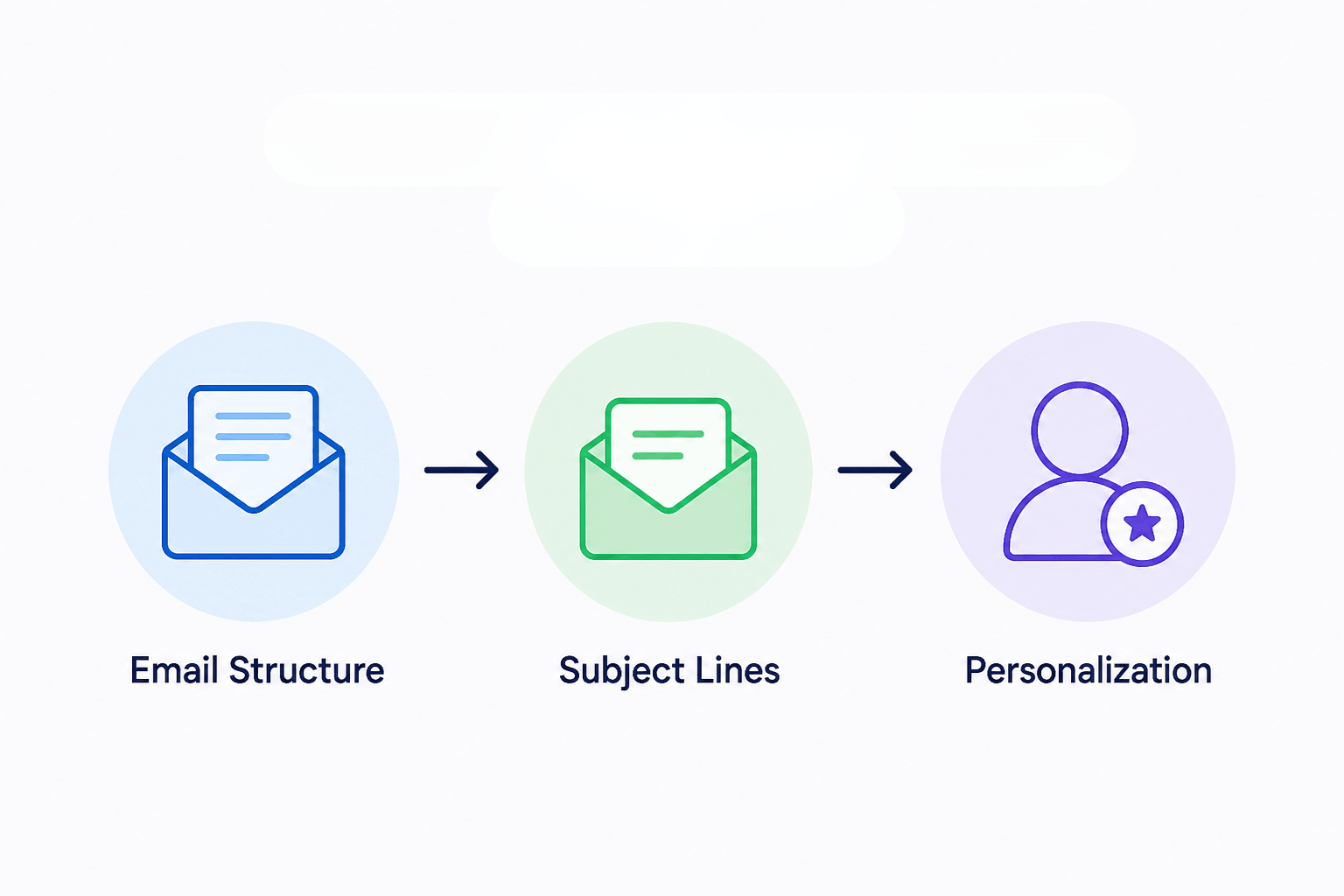
5. Writing High-Converting Cold Emails: Structure, Subject Lines & Personalization
A successful cold email isn't about sending a sales pitch—it's about starting a meaningful conversation. The most effective outreach emails are concise, relevant, and personalized to the recipient's needs rather than focused on your company or product. From the subject line to the closing call-to-action, every element should encourage the recipient to open the email, read it quickly, and take the next step. By combining a proven email structure with compelling subject lines and thoughtful personalization, you can significantly improve open rates, reply rates, and overall campaign performance.
Build Your Email Around the Recipient
Every cold email should follow a simple structure that keeps the recipient engaged. Begin with a personalized opener that references something specific about the person or their company instead of using generic greetings. Explain why you're reaching out to them specifically and demonstrate that you've done your research. Next, clearly communicate the value you can provide by focusing on the problem you solve rather than listing product features. Finally, end with a soft, low-commitment call-to-action such as asking if they'd be open to a brief conversation or whether they're the right person to speak with.
Keep Your Message Clear and Concise
Cold emails should be easy to read and ideally stay within 100–150 words, as most recipients check emails on mobile devices. Focus on one objective per email and include only a single call-to-action. Write in a conversational tone, as though you're emailing a colleague rather than creating a marketing brochure. Keep formatting simple by avoiding excessive colors, images, logos, or HTML-heavy templates. Plain-text emails often appear more authentic and consistently achieve better engagement.
Write Subject Lines That Encourage Opens
Your subject line determines whether your email gets opened or ignored. Keep it short—typically 3 to 6 words so it displays well on mobile devices. Casual, natural language often performs better than overly promotional or formal wording. Whenever possible, reference something specific such as the recipient's company, a recent LinkedIn post, a mutual connection, or a business initiative. Avoid spam-triggering words like "Free," "Guaranteed," "Limited Time," excessive punctuation, or ALL CAPS, as these can reduce deliverability and credibility. Most importantly, ensure the subject line accurately reflects the content of your email rather than relying on clickbait.
Examples of effective subject lines:
Personalize at Scale
Personalization is one of the biggest factors influencing reply rates, but writing every email from scratch isn't practical for larger campaigns. Many businesses use a tiered approach to balance efficiency with relevance. For high-value prospects, create fully customized emails that reference recent achievements, company news, funding announcements, job changes, or LinkedIn activity. For medium-sized campaigns, combine merge fields with dynamic personalization using prospecting tools that automatically pull company data, technology stack, or recent business events. For larger outreach campaigns, segment your audience by industry, job role, or common pain points and tailor your messaging to each group instead of sending a generic email to everyone.
Effective personalization goes beyond simply inserting a recipient's first name into a template. It should demonstrate a genuine understanding of the recipient's business, challenges, or goals. When your message feels relevant and valuable, prospects are far more likely to engage, respond, and continue the conversation.
6. Follow-Up Sequences
The first cold email rarely gets the reply. Most positive responses come after well-timed follow-ups because prospects are often busy or simply miss the initial message. A structured follow-up sequence keeps your outreach professional, increases visibility, and gives recipients multiple opportunities to respond without feeling overwhelmed.
A typical follow-up sequence:
Day 0: Send your initial cold email.
Day 3: Follow up with a fresh angle or an additional insight instead of simply asking if they saw your previous email.
Day 7: Share something valuable, such as a case study, relevant resource, customer success story, or industry insight.
Day 14: Try a different approach or send a short, friendly email that repositions your value.
Day 21: Send a polite breakup email, such as "Should I close the loop on this?" This often encourages recipients to reply, even if it's just to say they're not interested.
Best Practices
Make every follow-up provide new value instead of repeating the same message.
Keep follow-up emails shorter than the original email.
Stop the sequence immediately if the prospect replies.
Aim for 4–6 touchpoints, as this is generally the most effective balance between persistence and avoiding email fatigue.
For higher volume, many teams use multiple sending domains/inboxes routed through one sequencing tool to keep per-inbox volume low while scaling total outreach.
| Function | Example Tools |
|---|
| Prospecting/data | Apollo, Clay, ZoomInfo, LinkedIn Sales Navigator |
| Email verification | NeverBounce, ZeroBounce, MillionVerifier |
| Sending/sequencing | Instantly, Smartlead, Lemlist, Apollo, Outreach, Salesloft |
| Warm-up | Instantly warmup, Lemwarm, Mailwarm |
| Deliverability testing | mail-tester.com, Google Postmaster Tools, GlockApps |
| CRM | HubSpot, Pipedrive, Salesforce |
8. Measuring Cold Email Campaign Success: Key Metrics That Matter
Tracking the right metrics is essential for understanding how well your cold email campaigns perform and identifying areas for improvement. While open rates were once considered the primary success metric, modern privacy updates have made them less reliable. Today, businesses should focus on engagement and conversion metrics that reflect genuine prospect interest and campaign effectiveness.
Key Metrics to Monitor
Deliverability Rate: Measures the percentage of emails that successfully reach recipients' inboxes instead of bouncing or being blocked. A healthy deliverability rate is typically 95% or higher.
Open Rate: Indicates how many recipients opened your email. Although useful as a general indicator, it has become less accurate due to email privacy features from providers like Apple Mail.
Reply Rate: Shows the percentage of recipients who respond to your email. This is one of the most valuable metrics because it reflects how relevant and engaging your messaging is.
Positive Reply Rate: Tracks replies from prospects who express genuine interest, such as requesting more information or agreeing to a conversation. This metric provides a clearer picture of campaign quality than total replies alone.
Meeting or Booking Rate: Measures how many conversations result in scheduled meetings, demos, or sales calls. It directly reflects how effectively your outreach converts prospects into opportunities.
Bounce Rate: Represents emails that couldn't be delivered because of invalid or outdated addresses. Keeping the bounce rate below 2–3% helps protect your sender reputation.
Spam Complaint & Unsubscribe Rate: Tracks recipients who mark your email as spam or opt out. Maintaining these rates below 0.1% is important for preserving strong inbox placement and long-term deliverability.
By regularly monitoring these KPIs, you can identify what's working, improve campaign performance, and make informed decisions based on meaningful data rather than vanity metrics. In most cases, reply rate, positive reply rate, and meeting rate are the strongest indicators of a successful cold email campaign.
A/B testing is one of the most effective ways to optimize cold email campaigns. Instead of relying on assumptions, it helps you identify which elements generate higher open rates, replies, and conversions. To get accurate insights, test only one variable at a time so you can clearly measure what influenced the results.
Elements You Can A/B Test
Subject Line: Experiment with different wording, personalization, or length to see which version encourages more opens.
Opening Line: Test different personalization approaches, such as referencing a recent company update, LinkedIn activity, or a common pain point.
Call-to-Action (CTA): Compare simple CTAs like "Would you be open to a quick call?" versus "Can I send you more information?" to determine which drives more responses.
Email Length: Test shorter, concise emails against slightly more detailed versions to understand what resonates best with your audience.
Send Time & Day: Try sending emails on different weekdays and times to identify when your prospects are most likely to engage.
For reliable results, send at least 50–100 emails per variation before comparing performance. Allow one test to finish before starting another, ensuring your decisions are based on clear data rather than overlapping changes. Over time, continuous A/B testing helps improve reply rates, conversions, and the overall success of your cold email campaigns.
10. Common Cold Email Marketing Mistakes to Avoid
Even a well-written cold email campaign can fail if common best practices are overlooked. Many businesses focus heavily on writing the perfect email while ignoring the technical setup, audience targeting, and campaign strategy that determine long-term success. Avoiding these mistakes can significantly improve deliverability, engagement, and reply rates.
Mistakes That Can Hurt Your Campaign
Sending from a New Domain Too Quickly: Launching high-volume campaigns from a brand-new domain without warming it up often leads to poor deliverability and spam placement.
Focusing on Your Company Instead of the Prospect: Starting emails by talking about your business rather than the recipient's challenges makes the message feel promotional and less relevant.
Using Generic Personalization: Simply adding a recipient's name isn't enough. Personalized emails should reference the prospect's company, role, or recent activity to feel genuine.
Including Too Many Calls-to-Action: Asking prospects to book long demos or make major commitments in the first email can reduce response rates. Keep the CTA simple and low-pressure.
Skipping Follow-Up Emails: Many replies come after multiple touchpoints. Stopping after one email means missing valuable opportunities to engage interested prospects.
Ignoring Deliverability Metrics: Failing to monitor bounce rates, spam complaints, and sender reputation can gradually reduce inbox placement without obvious warning signs.
Using Low-Quality Email Lists: Purchasing outdated or unverified contact lists often results in high bounce rates and damages your sender reputation.
Sending the Same Email to Everyone: Different industries, job roles, and buyer personas have different needs. Segmenting your audience allows you to deliver more relevant messaging and achieve better results.
Avoiding these common mistakes helps create more effective cold email campaigns, improves inbox placement, and increases the likelihood of turning prospects into qualified leads.
11. Proven Cold Email Templates for Higher Reply Rates
Having a proven email structure can save time while improving your chances of getting replies. The best cold email templates are concise, personalized, and focused on the prospect's needs rather than your product. Use these templates as a starting point and customize them based on your audience, industry, and outreach goals.
Template 1: Pain-Point Focused Outreach
Subject: Quick question about [specific process]
Hi [First Name],
I noticed [Company] is [specific researched detail]. Businesses at this stage often face challenges with [relevant pain point].
We help companies solve exactly that. For example, [Customer Name] achieved [specific result] within [timeframe] using our solution.
Would you be open to a quick conversation to see if this could be relevant for your team?
Best,
[Your Name]
Template 2: Referral or Mutual Connection
Subject: [Mutual Connection] suggested I reach out
Hi [First Name],
[Mutual Connection] mentioned you're currently working on [specific initiative] and thought it would make sense for us to connect.
We help teams like yours [brief value proposition], and I believe it could be relevant to your current goals.
Would you be open to a quick 15-minute conversation this week or next?cc
Best,
[Your NAME]
12. Conclusion
Cold email marketing remains one of the most effective ways to generate B2B leads when done strategically. By targeting the right audience, maintaining strong email deliverability, personalizing your outreach, following up consistently, and optimizing campaigns through testing and performance metrics, businesses can build meaningful conversations and increase conversions. Focus on providing value rather than making a sales pitch, and your cold email campaigns will deliver stronger long-term results.